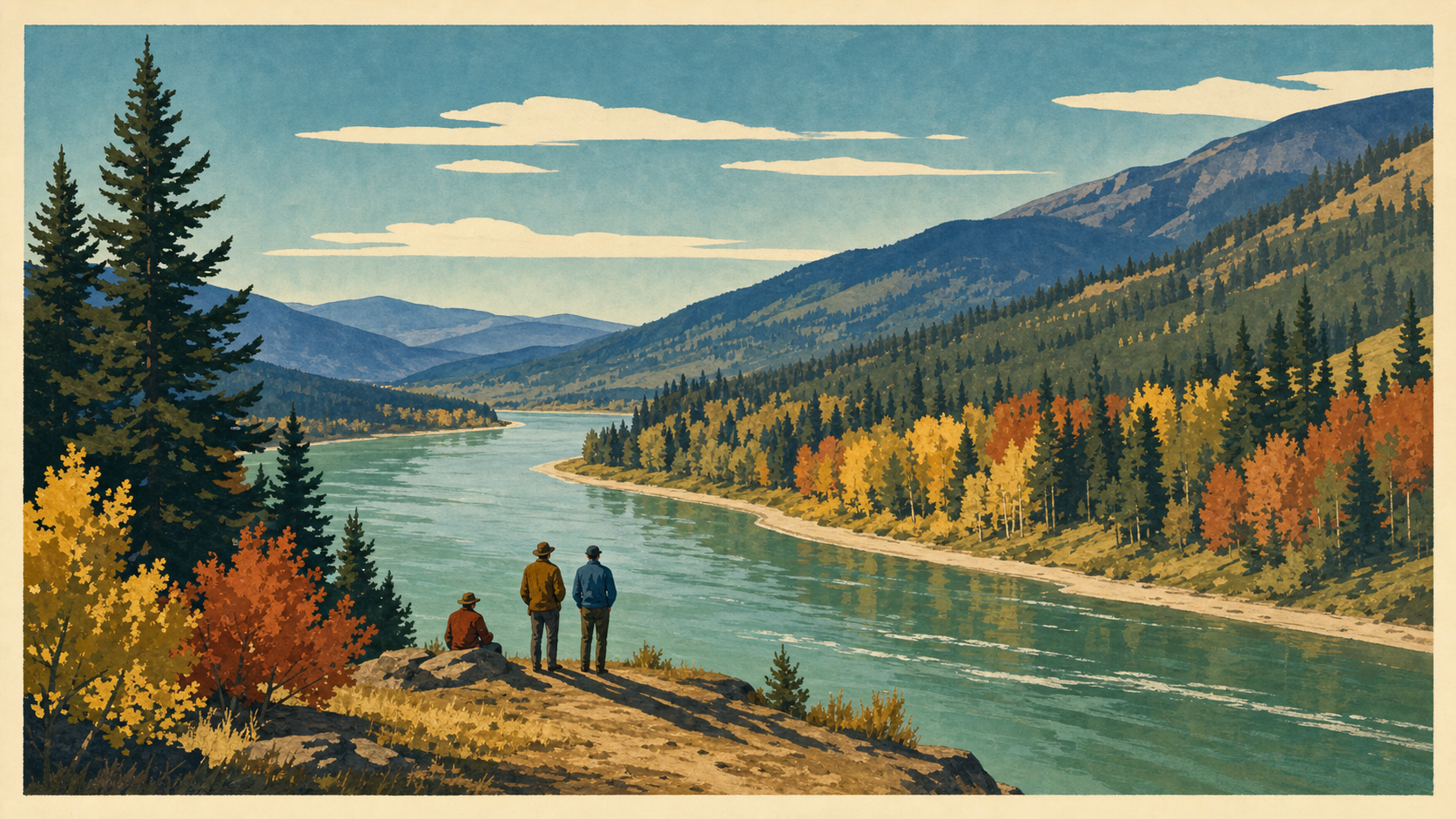
Best Time to Visit St. Maries, Idaho: Seasonal Activities Year-Round
When to visit St. Maries, Idaho — what each season offers for river time, trails, snow, and quiet, plus the planning cautions for each.
The best season for St. Maries depends on what you want from the water. Summer — roughly late June through early September — is the most reliable stretch for river time, boating, and open forest roads, and it's when nearly every seasonal facility is running. Fall brings colour, quiet, and comfortable hiking. Winter is genuinely quiet and works for snowmobiling and day trips to nearby skiing, with real driving caution. Spring is the most variable: green, uncrowded, and unpredictable.
If you want one answer: late summer into early fall, if you can handle the possibility of wildfire smoke.
Season at a glance
| Season | General feel | Best for | Best suited to | Plan around |
|---|---|---|---|---|
| Summer (late Jun–early Sep) | Warm, green, busiest | River days, boating, fishing, garnet digging, festivals | Families, groups, first visits | Smoke and fire restrictions; Labor Day crowds |
| Fall (mid Sep–Oct) | Crisp, colourful, quiet | Hiking, scenic drives, photography | Couples, hikers, people avoiding crowds | Hunting season; early weather turns; seasonal closures |
| Winter (Nov–Mar) | Cold, quiet, snow-dependent | Snowmobiling, nearby skiing, genuine quiet | Snow travellers, people wanting solitude | Road and pass conditions; short daylight; limited services |
| Spring (Apr–early Jun) | Wet, green, unpredictable | Low-elevation walks, birding, drives | Flexible travellers, budget trips | High water; mud; facilities not yet open |
Summer: the water season
Summer is why most people come. The St. Joe River is the centre of it — <cite>66.3 miles of the river carry federal Wild and Scenic designation</cite>, and the stretch near town is broad and slow enough for boating, paddling, and fishing.
What's running in summer:
- Shadowy St. Joe Campground, 10.6 miles up St. Joe River Road, with docks, a boat ramp, and a day-use picnic shelter. It sits on a slack-water section of the river.
- Heyburn State Park at full operation — three lakes, boat rentals in season, and the Trail of the Coeur d'Alenes running through.
- Emerald Creek Garnet Area, which is open Thursday through Saturday only, from the Thursday of Memorial Day weekend through the Saturday of Labor Day weekend. Reservation-only through Recreation.gov, no walk-ups. This is the tightest seasonal window in the area — book before you travel.
- Hobo Cedar Grove picnic area, listed as a May-to-September site.
Events. Paul Bunyan Days over Labor Day weekend is the town's big one — a four-day logging festival held since 1968, with competitions, a carnival, a parade, and fireworks, drawing around 27,000 people to a town of 2,300. Admission and parking are free except for the demolition derby, and pets aren't allowed in the park. There's also been a summer arts festival at Cherry Bend and a fly-in breakfast at the local airport in July. Check the St. Maries Chamber calendar for current dates — these move.
What to plan around. Late summer in the Idaho Panhandle can bring wildfire smoke and fire restrictions. Neither is predictable, and neither is guaranteed. What you can do is check conditions before you commit to an outdoor day, and have an indoor or driving alternative ready. Campfire rules change with conditions — check with the St. Joe Ranger District, (208) 245-2531.
Fall: the quiet season
Mid-September through October is arguably the nicest time here if you don't need to swim.
The crowds vanish after Labor Day. Temperatures drop into comfortable hiking range. The mixed forest along the river valleys turns — larch and cottonwood going gold against the dark evergreen — and the scenic drives are at their best. Photography is excellent in October.
Good fall activities: hiking the shorter forest routes, driving the St. Joe River Road, walking or riding flat sections of the Trail of the Coeur d'Alenes, and day trips north to Old Mission State Park.
What to plan around. Autumn is hunting season across the surrounding national forest. If you're walking on forest land, wear blaze orange and stay aware. Seasonal facilities begin closing — Emerald Creek shuts after Labor Day weekend, and campgrounds and picnic areas wind down. Weather can turn quickly at elevation; a warm afternoon in the valley doesn't mean a warm afternoon on a ridge.
Details in the easy hikes near St. Maries guide.
Winter: quiet, and snow-dependent
Winter here is genuinely quiet. Fewer visitors, short days, and a small town going about its business. It suits people who want that, and doesn't suit people expecting a resort atmosphere.
Snowmobiling is the main local winter activity. Idaho Parks and Recreation runs a grooming program covering the St. Maries and Clarkia areas, and the larger Silver Valley system to the northeast — state designated area #40, ranging from about 2,700 to 5,000 feet, with a prime season generally December through March.
If you're bringing a sled: Idaho requires every snowmobile to be registered with IDPR on or before November 1 each year. Non-residents need a nonresident user certificate, priced at $59.50 for a year at last check, with no short-term option. Groomer stickers may be required on some trail systems. Sort this out before you travel.
Downhill skiing means a day trip. Silver Mountain Resort at Kellogg is the closest full-size area — published figures put it at 1,600 skiable acres across 67 trails with about 2,197 feet of vertical, reached by a gondola from the valley floor, with night skiing on a portion of the mountain. Its published average annual snowfall is around 300 inches, but an average is not a promise for the week you're visiting. Check the resort's own conditions page and lift status before committing. Allow roughly an hour and a quarter each way, more in poor conditions.
Lower-key winter options include snowshoeing and cross-country skiing on flat sections of the Trail of the Coeur d'Alenes, and simply driving the river road on a clear cold day.
What to plan around — and this is the important part. Road, snow, avalanche, trail, and resort conditions change fast and can change while you're out. Check Idaho 511 for highway conditions, the Idaho Panhandle Avalanche Center for backcountry avalanche information, and the resort or ranger district for anything specific. Carry chains, extra layers, food, and water. Daylight is short. Services close early or close entirely.
The winter in St. Maries guide goes deeper on all of this.
Spring: green and unpredictable
April into early June is the shoulder season, and the honest description is variable.
The upside: everything is green, waterfalls and creeks run high, birdlife is active in the wetlands around the lower St. Joe and Heyburn, and you'll have most places to yourself. It's the cheapest and quietest time to come that isn't winter.
The downside: high water, mud, and closures. Snowmelt raises river levels and speeds current — the upper St. Joe carries Class II–IV whitewater in spring, which is expert territory and not a casual float. Forest roads at elevation may still be snowed in or too soft to drive. Many seasonal facilities haven't opened yet; Emerald Creek doesn't open until Memorial Day weekend, and picnic areas like Hobo Cedar Grove are listed as May-to-September sites.
Spring works if you're flexible, stick to lower elevations, and treat the itinerary as a set of options rather than a plan.
Choosing by traveller type
- Families with young children → July and August. Warmest water, everything open, longest days.
- Couples wanting quiet → late September and October. Colour, space, comfortable temperatures.
- Anglers → check Idaho Fish and Game for current seasons and rules before choosing dates. A current Idaho licence is required, and regulations vary by water and by year.
- Cyclists → May through October for the Trail of the Coeur d'Alenes. Shoulder months are cooler and emptier.
- Snow travellers → January and February, with flexible plans and a real weather habit.
- Anyone on a budget → spring or late fall, if you can accept that some things will be closed.
- First-time visitors → late August or early September, ideally either just before or just after Labor Day weekend depending on whether you want the festival or want to avoid it.
Know before you go
Nothing in this guide is a forecast. Snow, water levels, road access, fire restrictions, smoke, and event schedules all change, sometimes within a day. Before you set out:
- Idaho Parks and Recreation — Heyburn and Trail of the Coeur d'Alenes conditions and closures.
- St. Joe Ranger District, 222 S. 7th St. Suite 1, St. Maries, (208) 245-2531 — forest roads, campgrounds, fire restrictions, trail conditions.
- Idaho Fish and Game — all fishing and hunting licensing, seasons, and rules.
- Idaho 511 — highway conditions.
- Idaho Panhandle Avalanche Center — winter backcountry.
- St. Maries Chamber of Commerce — current event dates.
Frequently asked questions
What is the best month to visit St. Maries, Idaho? August and early September are the most reliable for warm weather, open facilities, and river conditions. Late September into October is the better choice if you'd rather hike than swim, and want the town quiet. Both come with a caveat: late summer can bring wildfire smoke, and autumn brings hunting season on surrounding forest land.
Is St. Maries worth visiting in winter? It depends on what you want. Winter is quiet, services are limited, and snow is never guaranteed. It works well if you're snowmobiling — Idaho runs a grooming program covering the St. Maries and Clarkia areas — or using the town as a base for a day trip to Silver Mountain at Kellogg. It doesn't work as a resort-style winter holiday.
When can you swim in the St. Joe River? Realistically July and August, when water temperatures are highest and levels have dropped from spring runoff. Even then the river is cold, and there's no supervised swimming area near St. Maries. Spring high water makes river recreation genuinely hazardous. See our St. Joe River recreation guide for access points and safety detail.
How bad is wildfire smoke in North Idaho? It varies enormously year to year and can't be predicted in advance. Some late summers are clear; others have stretches of poor air quality. If you're travelling in August or early September and anyone in your group is sensitive, check current air quality before outdoor days and keep an indoor or driving alternative in reserve.
Is there skiing near St. Maries? Not in town. Silver Mountain Resort at Kellogg is the nearest full-size ski area, roughly an hour and a quarter away depending on route and winter road conditions. Check the resort's own conditions and lift status before you drive — and check highway conditions too.
When is Paul Bunyan Days? Labor Day weekend, as it has been since 1968. It's four days of logging competitions, a carnival, a parade, and fireworks, drawing around 27,000 people. If you want it, book accommodation early. If you'd rather avoid crowds, plan either side of that weekend. Check the official event site for current schedules.
735 Elm Drive works as a base in any season — with the caveat that what you'll actually be able to do depends on conditions the week you arrive. Our weekend guide and day trips guide cover how to build a flexible plan.